
“I’M DONE TIPTOEING AROUND FRAGILE EGOS.” — That’s the message many believe Sara Cox is sending as she finally breaks her silence following the dramatic shake-up at the BBC—a shake-up that saw Scott Mills abruptly exit and left a noticeable gap in the broadcaster’s lineup.
What was initially framed as a routine reshuffle has quickly evolved into something far more charged. Cox stepping into a more prominent role—particularly amid the fallout from Mills’ departure—has placed her at the center of a storm that blends internal politics, public scrutiny, and a shifting culture within one of the UK’s most influential media institutions.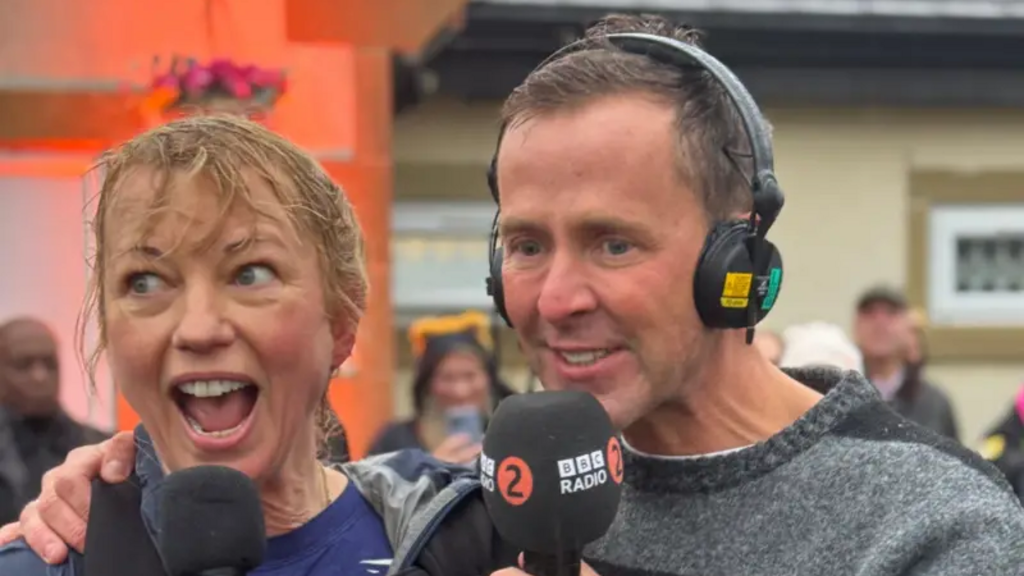
But if there were expectations that she would remain neutral or diplomatic, her tone has suggested otherwise.
Behind the scenes, the transition hasn’t been as seamless as it might appear on air. Insiders describe an atmosphere that’s tense, uncertain, and, in some corners, deeply divided. Long-standing relationships have been disrupted, routines broken, and trust—once taken for granted—now feels more fragile than ever.
Cox, who has spent decades building her own reputation within the BBC, is no stranger to navigating complex environments. From her early days on radio to her evolution into one of the corporation’s most recognizable voices, she has often balanced humor with honesty. But this moment feels different. There’s an edge to her words now—one that hints at frustrations that may have been building quietly for years.
Her reference to “fragile egos,” though not directed at any one individual publicly, has been widely interpreted as a critique of the culture that exists behind closed doors. In an industry where image and hierarchy often carry as much weight as talent, such a statement doesn’t land lightly.
Some believe it’s a subtle warning to senior figures—an indication that she’s no longer willing to shield internal dynamics from public view. Others see it as a broader commentary on the pressures faced by broadcasters who are expected to maintain a polished front while navigating complicated realities internally.
Either way, the timing is impossible to ignore.
Cox’s rise into a more visible role coincides directly with Mills’ departure—a moment that has already raised questions about decision-making within the BBC. His exit, sudden and largely unexplained in detail, has left both staff and audiences searching for clarity. Against that backdrop, Cox’s willingness to speak candidly feels like a shift in tone for the organization as a whole.
There’s also the matter of perception.
For years, the BBC has cultivated an image of stability and professionalism, even during periods of change. But recent events have begun to challenge that narrative. The removal of familiar voices, the reshuffling of key roles, and now the emergence of more outspoken commentary from within—together, they paint a picture of an institution in transition.
Cox appears to be embracing that transition rather than resisting it.
Those close to her suggest that stepping into this moment has brought a renewed sense of purpose. Rather than simply filling a gap, she seems intent on redefining what her presence represents. There’s a sense that she’s not just continuing a legacy—she’s reshaping it.
Part of that involves authenticity.
In an era where audiences are increasingly drawn to voices that feel real and unfiltered, Cox’s approach may resonate more than ever. Her willingness to acknowledge imperfections—both personal and institutional—could strengthen her connection with listeners who are themselves navigating a world that feels less certain than it once did.
But that authenticity comes with risks.
Speaking openly about internal culture, even indirectly, can create tension. It can unsettle colleagues, challenge leadership, and invite scrutiny from outside the organization. For someone in Cox’s position, every word carries weight—not just as an individual, but as a representative of the BBC itself.
And yet, she seems prepared for that.

There’s a growing sense that this moment marks the beginning of a new phase—not just for Cox, but for the BBC more broadly. A phase where traditional boundaries between public persona and private reality become less rigid, where conversations that were once kept behind closed doors begin to surface more openly.
Whether that shift will lead to meaningful change remains to be seen.
For now, the focus remains on what comes next. Cox’s expanded role places her at the forefront of the BBC’s evolving identity, particularly in areas like coverage of major events such as the Eurovision Song Contest, where she is expected to bring her own style and perspective.
It’s a significant responsibility—but also an opportunity.
If she succeeds, she could help redefine how audiences engage with the BBC, bringing a sense of transparency and relatability that feels aligned with the current media landscape. If tensions escalate, however, her outspokenness could become a focal point for further controversy.
Either way, the era of quiet transitions appears to be over.
What makes this moment especially compelling is the contrast between past and present. For years, changes within the BBC often unfolded gradually, with careful messaging and controlled narratives. Now, the pace feels faster, the tone sharper, the stakes higher.
Cox’s voice—both literally and figuratively—has become part of that shift.
And perhaps that’s what makes her stance so striking. It’s not just what she’s saying, but the fact that she’s saying it at all. In an environment where caution has often been the norm, her willingness to challenge that culture suggests a different kind of leadership—one rooted not in maintaining appearances, but in confronting realities.
As audiences tune in, they’re not just hearing a familiar presenter in a new role. They’re witnessing a moment of transformation—one that raises bigger questions about power, accountability, and the future direction of one of the world’s most iconic broadcasters.
So is this the start of a more outspoken, unfiltered BBC?

If Sara Cox’s words are anything to go by, the answer might already be unfolding—one conversation at a time.


