
The landscape of professional women’s basketball experienced a seismic shift during a memorable mid-July contest in Las Vegas. Inside the packed Michelob ULTRA Arena, a regular-season matchup transformed into a historic exhibition of tactical dominance, individual brilliance, and a complete systemic breakdown of the reigning powerhouse franchise. The Indiana Fever did not merely secure a victory against the Las Vegas Aces; they orchestrated a relentless campaign that shattered nine separate WNBA league and franchise records in a single evening. Beyond the statistical demolition, a tenth record emerged from the wreckage of the box score—a historic marker of an unprecedented performance collapse belonging entirely to the hosting Aces. The stark contrast between Indiana’s historic execution and Las Vegas’s subsequent systemic failure has ignited passionate debates across the sports world, exposing a deep ideological divide between a rising young juggernaut and a veteran giant left searching for answers.
Before the opening tipoff, media attention focused almost exclusively on the physical status of Indiana’s marquee rookie guard, Caitlin Clark. Sidelined recently by a nagging back injury, rumors circulated regarding her availability and overall effectiveness against a formidable Las Vegas roster anchored by former Most Valuable Player A’ja Wilson. Head coach Stephanie White entered the arena with a definitive, highly disciplined workload management strategy. Protecting the long-term physical health of the franchise cornerstone remained paramount, prompting the coaching staff to place a strict cap on Clark’s playing time, limiting her to a range of twenty to twenty-five minutes. This restriction injected an immediate sense of tension into the arena; observers wondered how a youthful Indiana squad could withstand the offensive firepower of the Aces while their primary playmaker operated on a tight minutes restriction.
The ensuing performance answered those questions immediately, demonstrating that true superstar impact cannot be measured merely by volume, but rather by pure, unadulterated efficiency. Clark assumed control of the floor with absolute poise, treating her limited minutes not as a restriction, but as an opportunity to maximize every single possession. Her presence on the hardwood forced the Las Vegas defense to extend outward, creating massive driving lanes for her teammates and keeping the elite rim protectors of the Aces constantly off-balance. By the time the third quarter concluded, Clark delivered a precise pass to an accelerating teammate for a successful bucket, marking her six-hundredth career assist.
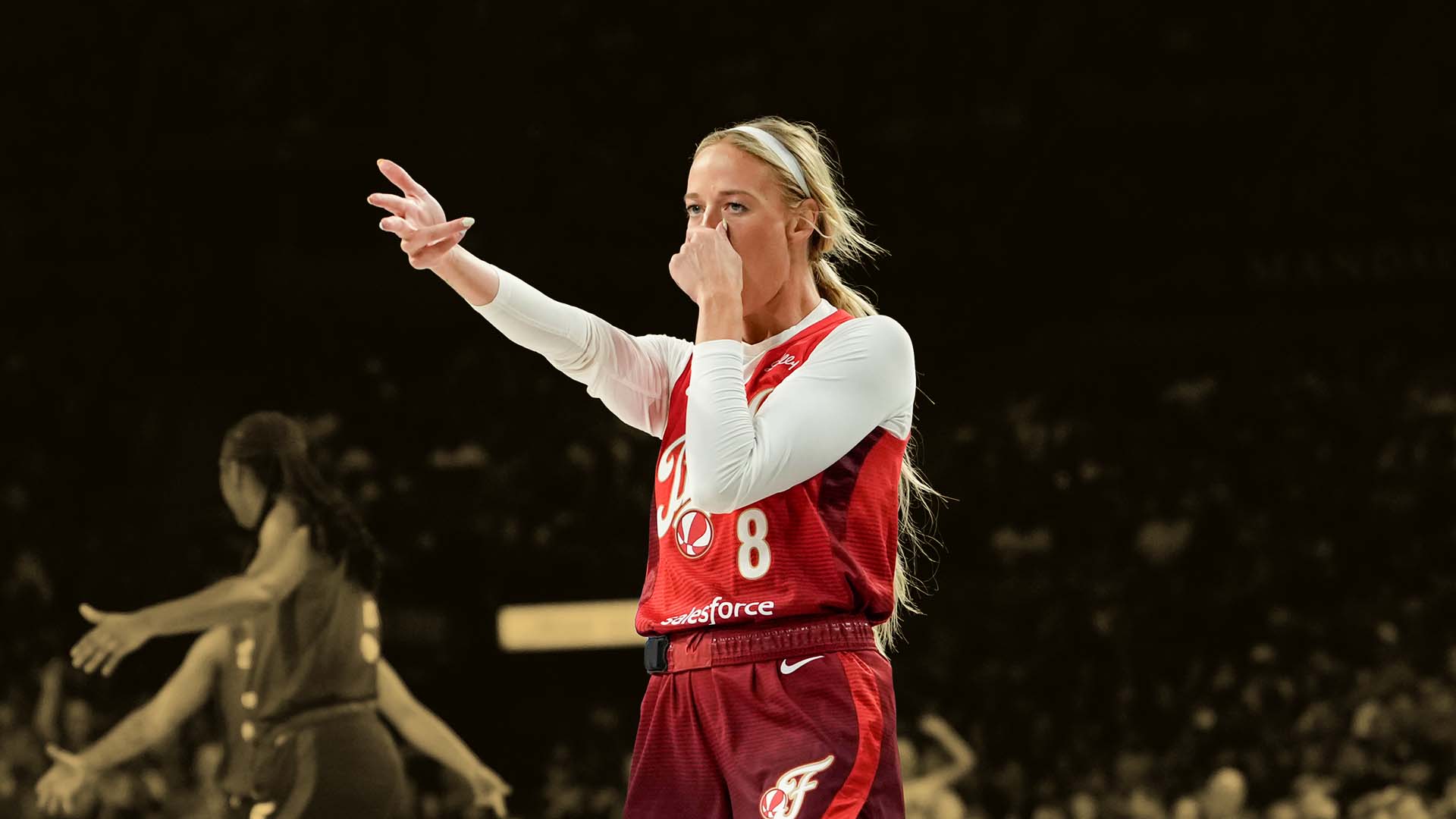
This moment represented a monumental milestone in the history of the WNBA. Clark secured her six-hundredth career assist in a mere seventy-two games, making her the fastest player in league history to reach that mark. To contextualize the gravity of this achievement, one must examine the trajectory of legendary playmaker Sue Bird, the all-time assist leader who accumulated her historic totals across nearly two decades of consistent, elite execution. Clark surpassed this foundational milestone in just over a season and a half of professional play, despite missing a significant portion of her sophomore campaign due to injury management. While scoring records often celebrate individual isolation capabilities, assist records speak to a player’s innate ability to elevate the performance of the entire collective. Clark’s historic pacing reinforces her status as an unprecedented offensive engine.
Furthermore, the game solidified another historic reality regarding Clark’s unique efficiency. Throughout the current season, the dynamic guard has averaged twenty and one-tenth points per contest while logging a mere twenty-nine and six-tenths minutes per game. This statistical profile represents the fewest minutes per game ever recorded by a guard in a twenty-point scoring season in WNBA history. The coaching staff’s commitment to managing her physical workload has inadvertently illuminated her historic efficiency; by producing elite scoring volumes within a restricted timeframe, Clark’s per-minute production challenges the traditional mathematical boundaries of standard guard play. She finished the evening with a remarkably well-rounded line of twelve points, seven rebounds, and six assists in just twenty-four minutes on the floor, directly anchoring two of the nine records broken by Indiana.
While the national media spotlight naturally gravitated toward Clark’s historic milestones, a veteran leader within the Indiana locker room engineered a brilliant offensive performance that flew quietly under the broader national radar. Kelsey Mitchell delivered a spectacular twenty-seven-point masterclass, embodying a stoic, business-like approach to elite competition. Mitchell has long eschewed self-promotion, consistently prioritizing physical preparation and on-court execution over media accolades. As the Las Vegas defense scrambled to contain Indiana’s perimeter ball movement, Mitchell methodically dismantled the defensive schemes of head coach Becky Hammon, collecting four distinct franchise and league records over the course of forty minutes.
Mitchell’s first milestone arrived the moment she stepped onto the hardwood, marking her three-hundredth career game in an Indiana Fever uniform. This accomplishment places her second in franchise history, trailing only the legendary Hall of Fame icon Tamika Catchings, a name revered as absolute scripture within the basketball-rich state of Indiana. Shortly after establishing this longevity milestone, Mitchell showcased her elite perimeter scoring capability, burying her seven-hundred and twenty-ninth career three-pointer. This successful shot propelled her past the legendary Katie Douglas for the seventh-most made three-pointers in the history of the WNBA, placing Mitchell’s name alongside an elite tier of historical sharpshooters who defined the modern era of the sport.
The true brilliance of Mitchell’s evening, however, resided in her unmatched consistency. By scoring in double figures against the Aces, Mitchell recorded her thirty-eighth consecutive game with ten or more points, officially eclipsing Tamika Catchings’ previous franchise record. This ongoing streak underscores a remarkable resistance to cold shooting nights, defensive adjustments, or physical fatigue. Furthermore, her explosive output marked her sixth consecutive game scoring twenty-five or more points, maintaining an active scoring average of over twenty-seven points per contest during that blistering stretch. This achievement places her third all-time in WNBA history for consecutive twenty-five-point performances, trailing only Tina Charles’ seven-game streak in 2021 and A’ja Wilson’s historic eight-game run established earlier in 2024. In a poetic twist of irony, the very superstar Mitchell is actively chasing for this historical record was forced to watch this pursuit unfold from the opposing bench during a devastating home blowout.
As spectacular as Mitchell and Clark operated, the title of the most efficient individual performance of the evening belonged to an extraordinary contribution off the bench. Sophie Cunningham entered the contest and proceeded to deliver a shooting display that bordered on mathematical perfection, setting the record for the most efficient twenty-point game in the history of the Indiana Fever franchise. Cunningham dismantled the perimeter defense of the Aces by converting six of her seven three-point attempts, finishing the night with twenty points on near-perfect efficiency.
To fully comprehend the historical significance of Cunningham’s performance, sports analysts pointed directly to her true shooting percentage, which concluded at a staggering one hundred and eleven percent. Unlike standard field goal metrics, true shooting percentage meticulously factors in the added mathematical value of three-pointers and the precise efficiency of free throws. While an exceptional night for an elite professional shooter typically hovers within the sixty to seventy percent range, Cunningham’s output surpassed the one hundred percent threshold because her hyper-efficient three-point conversions vastly outstripped the expected point value of traditional field goal attempts. Since joining the Fever organization, Cunningham has maintained a blistering forty-three and three-tenths percent accuracy rate from beyond the arc, representing the highest three-point shooting percentage of any player across the entire WNBA landscape during that multi-season interval. Far from stagnating, she has elevated her execution to a career-high forty-three and five-tenths percent from deep this season, ensuring that Indiana possesses a perimeter weapon with an apparently limitless ceiling.
The statistical avalanche generated by Clark, Mitchell, and Cunningham ultimately fused into an overwhelming team performance that resulted in the second-largest margin of victory in the history of the Indiana Fever franchise. This was not a case of an isolated superstar dragging an stagnant roster across the finish line; rather, it represented a holistic, fluid offensive ecosystem operating in perfect synchronization. Six separate Indiana players concluded the evening in double-digit scoring territory. Frontcourt anchor Aaliyah Boston delivered a phenomenal performance, completely neutralizing A’ja Wilson on the defensive end while simultaneously contributing a dominant double-double of nineteen points and eleven rebounds. Secondary options Ty Harris and Monique Billings provided crucial support off the bench, chipped in ten points apiece, and executed their defensive assignments with physical authority.
The underlying tracking data reveals that Indiana’s victory was forged through comprehensive physical and tactical superiority rather than fortuitous shooting variances. The Fever thoroughly dominated the glass, out-rebounding the veteran Aces by a margin of thirty-five to twenty-eight. Indiana displayed exemplary ball control and unselfishness, generating superior assist totals and maximizing defensive pressures to secure crucial steals while limiting individual turnovers. The shooting splits painted a picture of absolute dominance: Indiana converted a spectacular fifty-six percent of their two-point field goals and a blistering forty-eight percent of their long-range three-point attempts. Conversely, the Las Vegas offense cratered, managed a meager thirty-nine percent from the two-point area and an abysmal twenty-four percent from beyond the arc. Furthermore, Indiana demonstrated flawless execution at the free-throw line, knocked down eighteen of their nineteen attempts for a stellar ninety-five percent completion rate—a factor entirely independent of external officiating influence.
This comprehensive thrashing directly produced the tenth and most shocking record of the night, an unprecedented statistical anomaly that will forever remain a dark stain on the historic legacy of the Las Vegas Aces. Just one game prior to this matchup, the Aces had secured a monumental forty-eight-point victory over the Phoenix Mercury—a performance hailed by national commentators as a terrifying demonstration of championship form. Yet, a mere forty-eight hours later, the exact same roster, operating under the exact same coaching staff, suffered a catastrophic thirty-four-point demolition on their home hardwood against Indiana.
When sports analysts calculated the net calculation of this immediate back-to-back sequence, it revealed a staggering eighty-two-point point differential swing from one game to the next. This dramatic freefall represents the single largest game-to-game performance swing in the entire history of the WNBA. A collapse of this magnitude cannot be dismissed as a minor shooting slump or an ordinary dry spell; it signifies an absolute systemic failure of an elite roster’s competitive identity within a forty-eight-hour window.
The profound divergence between the two organizations became even more pronounced during the postgame press conferences, exposing a stark contrast in organizational culture and competitive maturity. Facing a barrage of media inquiries regarding the historic nature of the defeat, superstar forward A’ja Wilson focused significantly on the nature of the officiating, suggesting that the game’s structural flow was severely disrupted by skeptical whistle calls and frequent video reviews that favored the visitors. Head coach Becky Hammon, while subtly distancing herself from direct criticism of the referees, directed blame toward a grueling league schedule, noting that playing three games within a four-day window against the fastest, most physical transition team in the league would inevitably compromise any elite defense. Hammon emphasized the intense physical toll that banging against a relentless interior defender like Aaliyah Boston takes on a player’s body over forty minutes, framing the defeat primarily as a consequence of extreme physical fatigue and adverse scheduling.
However, a cold, analytical examination of the final box score completely invalidates these defensive arguments. Rebounding position, structural ball movement, and the active avoidance of unforced turnovers are disciplined attributes rooted entirely in effort, focus, and fundamental execution—none of these elements are dictated by a referee’s whistle. Drained bench players executing wide-open perimeter shots and fighting for loose balls are the hallmarks of a highly motivated, well-prepared collective, not the beneficiaries of favorable officiating pacing. While Las Vegas locker room conversations continually circled back to external variables such as travel weariness, officiating flow, and scheduling frustrations, the Indiana Fever occupied an entirely different intellectual space.
When Aaliyah Boston addressed the media, her commentary focused exclusively on pure basketball mechanics. She detailed how Indiana’s disciplined, aggressive half-court defense successfully ignited their transition offense, and how their commitment to reversing the basketball from side to side across the perimeter ensured that the ball invariably discovered the most open, efficient shooter on the floor. Boston spoke with the serene confidence of a champion, focused strictly on internal accountability, sustained consistency across four full quarters of basketball, and the rigorous execution of strategic principles.
This distinct ideological divergence is what truly separates a rising champion from a transitioning powerhouse. One franchise departed the arena consumed by external justifications for a historic collapse, while the other exited focused entirely on the mechanical replication of elite basketball habits. As the WNBA progresses through the competitive months of the 2026 season, this unforgettable night will be remembered as the moment the Indiana Fever proved their roster had finally unified into a dangerous, championship-caliber collective. With Caitlin Clark returning to peak physical health, Kelsey Mitchell continuing her historic assault on the record books, and Sophie Cunningham executing at a level that defies traditional shooting metrics, the rest of the league must confront a terrifying new reality. The era of undisputed veteran dominance has officially reached its conclusion, replaced by a sophisticated, multi-faceted Indiana juggernaut that refuses to look back.


